Bates Numbering Requirements by State: A Comprehensive Guide
Bates numbering requirements vary significantly by jurisdiction. Understanding federal rules, state-specific mandates, and compliance standards is essential for every legal professional handling document production. This guide covers the requirements you need to know.
Federal Requirements
Federal Rules of Civil Procedure set the foundation for document production requirements across all federal courts. While the rules don't explicitly use the term “Bates numbering,” courts have consistently interpreted them to require unique document identifiers.
FRCP Rule 34: Production of Documents
Federal Rule of Civil Procedure 34 requires that documents be produced “as they are kept in the usual course of business or organized and labeled to correspond to the categories in the request.” Courts routinely interpret “organized and labeled” to require sequential unique identifiers — which means Bates numbering.
⚖️ Court Interpretation
Federal courts consistently hold that “organized and labeled” means documents must have unique identifiers. Bates numbering has become the accepted standard for meeting this requirement. Failure to comply can result in court-imposed sanctions, adverse inference instructions, or orders to re-produce documents at the non-complying party's expense.
FRCP Rule 26(b)(5): Privilege Claims
Rule 26(b)(5) requires parties to describe withheld documents with sufficient detail to allow other parties to assess privilege claims. Bates numbering makes this practical — privilege logs reference specific Bates numbers or ranges, making it possible to identify exactly which documents have been withheld and why.
FRCP Rule 37: Sanctions for Non-Compliance
Rule 37 empowers courts to impose sanctions when parties fail to comply with discovery obligations. Courts have ordered re-production, fee-shifting, and even adverse inference instructions when documents were produced without proper identification. Using Bates numbers from the start avoids these costly consequences.
Consequences of Non-Compliance
- Court orders to re-produce all documents with proper numbering
- Attorney's fees and costs shifted to the non-complying party
- Adverse inference instructions to the jury
- Sanctions against attorneys personally
- Potential case dismissal in extreme cases
State-by-State Requirements
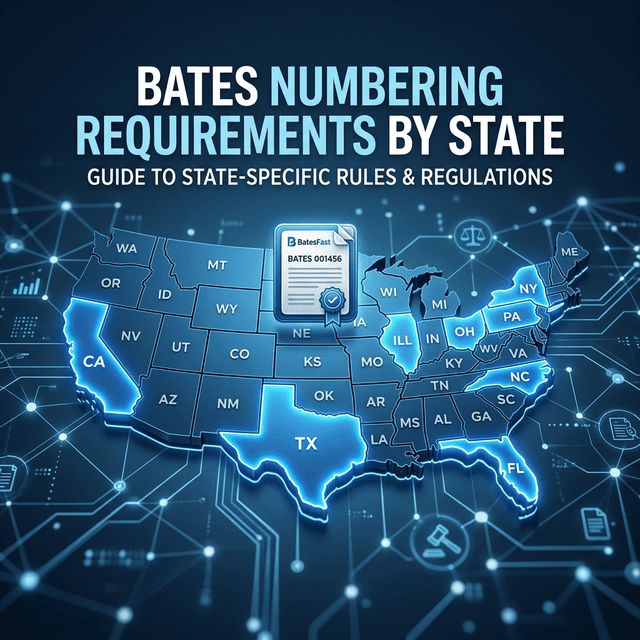
State court requirements for Bates numbering range from mandatory to strongly recommended. Below is a comprehensive overview of key jurisdictions. Always verify current local rules before production.
| State | Requirement Level | Key Rule | Notes |
|---|---|---|---|
| California | Strongly Recommended | CCP § 2031.280 | Most courts require unique identifiers |
| New York | Required (Commercial Div) | Rule 11-a | Mandatory in complex commercial cases |
| Texas | Recommended | TRCP Rule 196 | Standard practice; judges expect it |
| Florida | Required (Complex) | FRCP 1.280 | Complex litigation rules mandate it |
| Illinois | Recommended | Sup. Ct. Rule 214 | Expected standard practice |
| Pennsylvania | Required (Complex) | Pa. R.C.P. 4009.1 | Commerce case management orders |
| New Jersey | Required (Complex) | R. 4:18-1 | Multicounty litigation requires it |
| Massachusetts | Recommended | Mass. R. Civ. P. 34 | Business litigation session requires it |
| Georgia | Recommended | O.C.G.A. § 9-11-34 | Standard in complex civil litigation |
| Virginia | Recommended | Va. Sup. Ct. Rule 4:9 | Expected in larger productions |
| Washington | Recommended | CR 34 | King County requires for complex cases |
| Colorado | Required (Complex) | C.R.C.P. 34 | Complex civil litigation guidelines |
Key State Requirements in Detail
California
California Code of Civil Procedure § 2031.280 requires documents to be produced in the order in which they appear in the responding party's files, or organized and labeled to correspond to the categories in the request. While the statute doesn't use the term “Bates numbering,” California courts — particularly in Los Angeles, San Francisco, and Orange County — routinely require it. Many local court rules explicitly mandate unique sequential identifiers.
In complex litigation under CRC Rule 3.750, case management orders typically specify Bates numbering format, including prefix conventions and digit requirements. Solo practitioners and small firms should check their assigned judge's individual rules.
New York
New York's Commercial Division Rules make Bates numbering mandatory for document productions in complex commercial litigation. Rule 11-a specifically requires that documents be numbered sequentially and that privilege logs reference withheld documents by Bates number. The Commercial Division covers cases valued at $500,000 or more.
Even outside the Commercial Division, New York courts strongly expect Bates numbering in any production exceeding a few hundred pages. CPLR § 3122 provides the underlying authority for document organization requirements.
Texas
The Texas Rules of Civil Procedure (Rule 196) require organized document production. While not explicitly mandating Bates numbers, Texas judges universally expect them, particularly in cases involving large document sets. Many case management orders in Harris County, Dallas County, and Bexar County explicitly require sequential document identification. Texas courts have sanctioned parties for producing documents without proper identification.
Florida
Florida Rule of Civil Procedure 1.280 and the Complex Litigation Rules require document identification systems for large-scale discovery. Florida's complex litigation designation (cases assigned under Administrative Order) mandates Bates numbering in case management orders. The requirement extends to both paper and electronic productions. Miami-Dade, Broward, and Palm Beach counties have local rules reinforcing these requirements.
Pennsylvania
Pennsylvania's Commerce Program courts require Bates numbering for all document productions. Pa. R.C.P. 4009.1 governs document production, and Commerce Program case management orders specify numbering format requirements. Philadelphia's Commerce Program, in particular, has detailed e-discovery protocols that mandate sequential document identification.
New Jersey
Under R. 4:18-1, New Jersey courts require organized document production. The Multicounty Litigation (MCL) designation requires Bates numbering in all productions. Mass tort cases assigned to MCL judges follow standardized case management orders that specify numbering formats, prefix conventions, and production protocols.
Format and Compliance Standards
While specific format requirements vary by court and case, several standards have emerged as industry best practices that satisfy virtually all jurisdictions.
Number Format
Minimum Digits
Use at least 6 digits with leading zeros (e.g., 000001). This accommodates up to 999,999 pages and prevents numbering issues in large cases.
Prefix Convention
Use a 3-4 character prefix identifying the producing party (e.g., DEF000001 for defendant). This prevents numbering conflicts between parties.
Sequential Continuity
Numbers must be sequential across all documents in a production. Gaps indicate withheld documents and must be documented in a privilege log.
Supplemental Productions
Continue numbering from where the previous production ended. Never restart numbering at 000001 for supplemental productions.
Placement Requirements
- Position: Bottom-right corner is the most common requirement, though some courts accept bottom-center or bottom-left
- Font size: Minimum 10pt is standard; 12pt is recommended for readability
- Color: Black text on white background is universally accepted; avoid light colors that may not reproduce clearly in copies
- Margins: Place stamps within the page margins so they don't overlap with existing content
- Consistency: Maintain the same position, font, and size across all documents in a production
Common Compliance Mistakes
Restarting Numbers Between Productions
Each supplemental production must continue from the last number used. Restarting at 000001 creates duplicate numbers that cause confusion during depositions, motions, and trial. Track your last Bates number after every production.
Inconsistent Formatting
Changing your numbering format mid-case (e.g., switching from ABC-000001 to ABC000001) creates confusion and may draw sanctions. Choose a format at the outset and maintain it throughout all productions.
Overlapping Stamp Placement
Placing Bates stamps over existing text makes documents unreadable. Always preview your stamped documents and adjust placement to avoid covering content, headers, footers, or page numbers.
Missing Privilege Log Entries
Every gap in your Bates number sequence represents withheld documents that must be logged. Failure to maintain an accurate privilege log referencing Bates numbers can result in waiver of privilege claims.
Not Checking Local Rules
Requirements vary by court, judge, and case type. Always review your jurisdiction's local rules, the assigned judge's individual practices, and any applicable case management orders before your first production.
Best Practices for Meeting Requirements
Compliance Checklist
- Check local rules first: Review jurisdiction-specific requirements before every production
- Agree on format early: Establish numbering format in the Rule 26(f) conference or initial case management order
- Use consistent format: Maintain the same prefix, digit count, and placement throughout the case
- Document your system: Record your Bates numbering methodology and keep production logs
- Maintain privilege logs: Reference all withheld documents by Bates number range
- Keep production records: Track all Bates ranges, dates, and production volumes
- Quality check before delivery: Verify numbering accuracy on a sample of documents before sending
- Use reliable tools: Choose tools that ensure consistent, accurate numbering across all documents
Meeting Bates numbering requirements doesn't have to be complicated or expensive. Browser-based tools like BatesFast make it easy to apply consistent, professional Bates numbers that satisfy court requirements in any jurisdiction — without paying for expensive desktop software.
Frequently Asked Questions
Is Bates numbering legally required?
While no single statute universally mandates the term “Bates numbering,” federal and many state rules require unique document identifiers in discovery productions. Courts have consistently interpreted these rules to require sequential numbering systems, making Bates numbering the de facto legal standard.
What happens if I don't use Bates numbers?
Potential consequences include court orders to re-produce documents at your expense, monetary sanctions, attorney's fees awarded to opposing counsel, adverse inference instructions to the jury, and in extreme cases, contempt findings. The cost of re-production alone typically far exceeds the minimal time needed to apply Bates numbers correctly from the start.
How many digits should Bates numbers have?
Use a minimum of 6 digits (e.g., 000001) for most cases. For very large cases with potential for over one million pages, use 7 or 8 digits. It's better to use more digits than you think you'll need — you can't easily change the digit count mid-case without causing confusion.
Do small cases need Bates numbering?
Yes. Even in small cases, Bates numbering provides essential benefits: unique page identification for depositions, clear citation in motions, and professional presentation. Many courts require it regardless of case size. Modern tools like BatesFast make it quick and effortless — start with one free preview run to see for yourself.
Should I use prefixes in my Bates numbers?
Yes. Using a 3-4 character prefix (e.g., DEF for defendant, PLT for plaintiff) prevents numbering conflicts when multiple parties are producing documents. Discuss prefix assignments with opposing counsel during the initial discovery conference to avoid duplicates.
How do I handle supplemental productions?
Always continue numbering from where your previous production ended. If your last production ended at DEF005000, start the supplemental at DEF005001. Include a cover letter identifying the production as supplemental and referencing the Bates number range. Update your production index accordingly.
Can I use Bates numbering for electronic documents?
Absolutely. Electronic document productions follow the same Bates numbering principles as paper productions. PDFs are the standard format for e-discovery productions, and Bates numbers are stamped directly onto the PDF pages. Tools like BatesFast handle this entirely in the browser.
Where can I find my court's specific Bates numbering rules?
Check three sources: (1) the court's local rules, usually available on the court's website; (2) the assigned judge's individual practices or standing orders; and (3) any case management orders issued in your specific case. For federal courts, also review the district's e-discovery guidelines.
Conclusion
Bates numbering requirements exist across virtually every U.S. jurisdiction, from federal courts to state courts and specialized tribunals. While the specific rules vary, the underlying requirement is consistent: documents produced in litigation must have unique, sequential identifiers.
The safest approach is to apply Bates numbers to every document production, regardless of case size or court. Modern tools make this fast and effortless. By understanding the requirements outlined in this guide and using reliable tools like BatesFast ($299 one-time, free preview run), legal professionals can ensure compliance across any jurisdiction.
Ensure Compliance with Professional Bates Numbering
BatesFast helps you meet court requirements in any jurisdiction — secure and browser-based. One-time $299 purchase (€350 EUR). No installation, no subscription. Volume discounts for 10+ licenses.
Try BatesFast Now