The History of Bates Numbering: From Mechanical Stamps to Digital Tools
Bates numbering has evolved from a mechanical invention in the 1890s to sophisticated browser-based tools. This history reveals how a simple numbering machine became indispensable to legal practice worldwide — and why the name persists over 130 years later.
The Invention: Edwin G. Bates and the Automatic Numbering Machine
In the 1890s, Edwin G. Bates faced a problem that plagued offices, courthouses, and businesses everywhere: documents needed sequential numbers, and the only option was writing them by hand. It was slow, tedious, and error-prone. Clerks spent hours numbering pages one by one, and mistakes — duplicate numbers, skipped numbers, illegible handwriting — were inevitable.
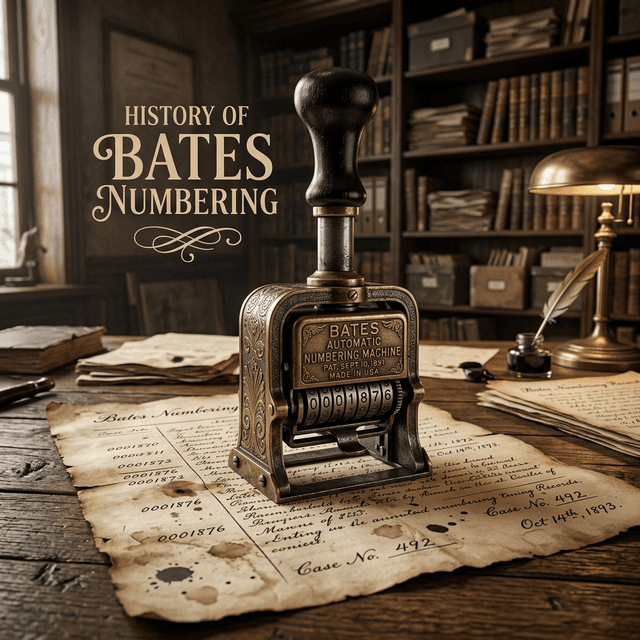
Bates' solution was the Bates Automatic Numbering Machine, a handheld mechanical device that stamped sequential numbers onto paper and automatically advanced to the next number after each impression. The invention was elegant in its simplicity: rotating number wheels displayed digits 0 through 9, and a spring mechanism incremented the wheels after each stamp.
🏛️ The Patent
Edwin G. Bates received a patent for his automatic numbering machine in the late 1890s. The Bates Manufacturing Company, based in Orange, New Jersey, produced the devices for decades. The company's machines became so ubiquitous that “Bates numbering” became a generic term — similar to how “Xerox” became synonymous with copying or “Google” with searching.
The invention was revolutionary for its time. A clerk who previously took hours to number a stack of documents could now stamp hundreds of pages in minutes. The machine guaranteed perfect sequential order and consistent, legible numbers on every page. Businesses adopted it quickly, and the legal profession — where document order and identification were critical — became the largest user base.
The Mechanical Era (1890s–1990s)
For nearly a century, mechanical Bates stamps dominated document management. The devices evolved from simple hand-operated models to more sophisticated versions, but the core mechanism remained the same.
How Mechanical Stamps Worked
Traditional Bates stamps were precision-engineered devices with several key components:
- Number wheels: Rotating wheels displaying digits 0-9, typically 6 to 8 wheels wide
- Ink pad: Built-in or external ink pad that provided ink for each impression
- Automatic advancement: A spring-loaded mechanism that incremented the rightmost wheel after each stamp, with carry-over to higher digits
- Prefix/suffix wheels: Optional letter wheels for adding alphabetical characters before or after the number
- Repeat function: Some models allowed stamping the same number multiple times before advancing
The Manual Process
Using mechanical Bates stamps required significant manual labor and careful attention:
- Set the starting number by rotating each wheel to the correct digit
- Ink the stamp pad or insert a fresh ink cartridge
- Position the document and press the stamp firmly onto the page
- Verify the impression is clear and legible
- The machine automatically advances to the next number
- Repeat for every page in every document
Paralegals and legal assistants routinely spent entire days stamping thousands of pages for a single case. The process was physically demanding — pressing the stamp thousands of times caused hand fatigue — and mistakes were difficult to correct. A skipped page or misaligned stamp meant starting sections over or creating handwritten corrections.
Manufacturers and Models
The Bates Manufacturing Company was the original and most prominent maker, but several competitors emerged over the decades. Trodat, Cosco, and other office supply manufacturers produced their own automatic numbering machines. Models ranged from basic 6-digit hand stamps costing a few dollars to heavy-duty electric models for high-volume operations. Despite the competition, the “Bates” name remained the generic term for any sequential document numbering machine.
Legal Adoption and Standardization (Early–Mid 1900s)
As litigation grew more complex throughout the 20th century, the need for reliable document identification became critical. Courts began requiring — or strongly expecting — unique identifiers on produced documents. Bates numbering filled this need perfectly.
By the mid-1900s, Bates numbering was standard practice in American litigation. Law firms, government agencies, and corporate legal departments all relied on mechanical stamps. The Federal Rules of Civil Procedure, adopted in 1938 and amended over the decades, increasingly emphasized organized document production — and Bates numbering became the accepted method for compliance.
Key Milestone
The 1970 amendments to the Federal Rules of Civil Procedure expanded discovery requirements significantly, driving a surge in document production volumes. Bates numbering became not just helpful but essential for managing the increasing flow of discovery documents.
The Digital Transition (1990s–2000s)
The rise of personal computers and digital documents in the 1990s transformed Bates numbering forever. As more documents existed only in electronic form, mechanical stamps became impractical for a growing portion of legal document management.
Early Digital Solutions
Software developers recognized the opportunity early. Adobe Acrobat, released in 1993, eventually added Bates numbering to its feature set, making digital stamping accessible to firms working with PDF documents. Specialized litigation support software like Concordance and Summation also incorporated Bates numbering capabilities. These early digital tools were expensive, required significant training, and ran only on specific operating systems.
Advantages of Digital Bates Numbering
The shift to digital tools brought transformative improvements:
Speed
Process thousands of pages in minutes instead of hours or days of manual stamping.
Accuracy
Eliminate human error in number sequencing — no skipped or duplicated numbers.
Consistency
Perfect alignment, font, and appearance on every single page.
Flexibility
Easy customization of format, position, font, size, and color.
Batch Processing
Number multiple documents sequentially in a single operation.
Searchability
Digital Bates numbers can be indexed and searched electronically.
Modern Era: Browser-Based Tools (2010s–Present)
The latest evolution in Bates numbering brings the process directly into the web browser. Technologies like WebAssembly allow complex PDF processing to happen entirely on the user's device, combining the convenience of web-based access with the security of local processing.
Tools like BatesFastrepresent this modern approach. Documents are processed client-side — they never leave the user's computer — eliminating data privacy concerns while providing instant access from any device with a browser. No installation, no subscription fees, no compatibility issues.
Modern Advantages
- No installation: Works immediately in any modern browser
- Cross-platform: Mac, Windows, Linux, ChromeOS — all supported equally
- Client-side security: Documents never leave your computer
- Affordable: One-time purchase — no recurring subscriptions or per-page fees
- Always current: No software updates to install or manage
- WebAssembly speed: Near-native processing performance in the browser
Timeline of Bates Numbering Evolution
1890s: The Invention
Edwin G. Bates patents the automatic numbering machine. The Bates Manufacturing Company begins production in Orange, New Jersey.
Early 1900s: Business Adoption
Businesses, banks, and government agencies adopt Bates stamps for record-keeping. Competitors enter the market.
1938: Federal Rules of Civil Procedure
FRCP adoption creates formal framework for document production in federal courts, accelerating legal adoption of Bates numbering.
1970s: Discovery Expansion
FRCP amendments expand discovery scope. Bates numbering becomes essential for managing increasing document volumes.
1993: Adobe Acrobat Launches
The PDF format begins its rise. Adobe Acrobat eventually adds Bates numbering features for digital documents.
2000s: Desktop Software Era
Specialized litigation software (Concordance, Summation, LAW PreDiscovery) provides advanced Bates numbering alongside document review.
2006: E-Discovery Amendments
FRCP amendments formally address electronically stored information (ESI), cementing digital Bates numbering as the standard.
2020s: Browser-Based Revolution
WebAssembly enables secure, fast, browser-based Bates numbering. Tools like BatesFast provide affordable, client-side processing with no installation or subscription.
Why the Name Persists
Despite the shift from mechanical stamps to browser-based tools, the term “Bates numbering” remains the universal standard. This linguistic persistence is remarkable — few other office technologies from the 1890s have their inventor's name embedded in daily professional vocabulary.
The term endures because it fills a specific niche: there's no better way to describe the practice of applying unique, sequential identifiers to document pages for legal and business purposes. “Document numbering” is too generic. “Sequential stamping” lacks the legal gravitas. “Bates numbering” carries over a century of legal tradition and is instantly understood by every legal professional in the English-speaking world.
Whether using a 1920s mechanical stamp or a 2026 browser-based tool, legal professionals worldwide still say they're “Bates numbering” their documents — a testament to the lasting impact of one inventor's elegant solution to a universal problem.
Frequently Asked Questions
Who invented Bates numbering?
Edwin G. Bates invented the automatic numbering machine in the 1890s. His company, the Bates Manufacturing Company, produced the devices in Orange, New Jersey. The machines became so widely used that “Bates numbering” became the generic term for sequential document identification.
When was the Bates numbering machine invented?
The Bates Automatic Numbering Machine was invented and patented in the 1890s. The exact year of the first patent varies in historical records, but commercial production was well underway by the turn of the 20th century.
Why is it called “Bates numbering”?
It's named after the inventor, Edwin G. Bates, and his company, the Bates Manufacturing Company. Like “Xerox” for copying or “Band-Aid” for adhesive bandages, the brand name became the generic term for the process itself. The term stuck because no better alternative emerged.
Are mechanical Bates stamps still used today?
Rarely. While mechanical stamps are still manufactured and available, the vast majority of Bates numbering is now done digitally. Physical stamps are occasionally used for one-off situations with paper documents, but digital tools are faster, more accurate, and more practical for modern legal workflows.
How has digital Bates numbering changed legal practice?
Digital tools transformed Bates numbering from a tedious, hours-long manual process to a task that takes seconds. This reduced costs for clients, improved accuracy, enabled batch processing of thousands of documents, and made Bates numbering accessible to solo practitioners who couldn't afford expensive litigation support software.
What is the future of Bates numbering?
The core concept — unique, sequential document identification — will remain essential as long as legal proceedings exist. The tools will continue evolving: browser-based processing, AI-assisted document organization, and tighter integration with e-discovery platforms. But the fundamental purpose won't change — Bates numbering solves a permanent problem in legal document management.
Conclusion
From Edwin G. Bates' mechanical invention to modern WebAssembly-powered browser tools, the history of Bates numbering reflects the broader evolution of legal technology. What started as a simple hand-stamping device has become an essential component of digital legal practice.
Today's tools would be unrecognizable to 19th-century clerks, but the purpose remains identical: ensure every page of every document has a unique, sequential identifier. The technology has changed; the need has not.
Experience the Latest Evolution
BatesFast represents the cutting edge of Bates numbering — fast, secure, and entirely browser-based. Start with one free preview run, then $299 one-time purchase (€350 EUR). No installation, no subscription.
Try BatesFast Now